
A nagging cough that won’t quit, a tight feeling in your chest, and fatigue that seems to sink into your bones bronchitis has a way of showing up quietly and then overstaying its welcome. Most cases start as a mild, viral illness that clears up in one to three weeks. But bronchitis doesn’t always stay mild. Left unchecked, it can drag on for months, disrupt your sleep and work, or even progress into something far more serious, like pneumonia.
Millions of people develop acute bronchitis every year, and for most, it feels like nothing more than a stubborn extension of a cold. That’s exactly what makes it tricky: the early stages are so unremarkable that it’s easy to push through work, skip rest, and assume the cough will simply fade on its own. In many cases it does.
But in others, the inflammation deepens, mucus thickens, and the airways struggle to keep up, setting the stage for complications that are far easier to prevent than to treat. If you notice even one of these nine symptoms, don’t wait it out; visit our Adult urgent care team for a same-day evaluation.”
What Are the Early Symptoms of Bronchitis?
Bronchitis develops when the bronchial tubes, the airways that carry air to and from your lungs, become inflamed and swollen, often following a cold or respiratory virus. In the first few days, the symptoms can look a lot like a common cold, which is exactly why so many people ignore them until the illness has already taken hold.
This overlap with cold symptoms is precisely why bronchitis so often gets underestimated. The body is still fighting off the initial viral infection while the bronchial tubes quietly become more irritated and swollen underneath. As the airway lining reacts to that irritation, it produces extra mucus, which is what eventually turns a dry tickle into the deeper, wetter cough that most people associate with bronchitis.
- A dry or mildly productive cough that starts out subtle
- Low-grade fatigue and a general run-down feeling
- A scratchy throat or mild throat irritation
- Slight chest discomfort when taking a deep breath
- A low-grade fever, usually under 100.4°F
- Nasal congestion or a runny nose left over from a cold
Which 9 Bronchitis Symptoms Should You Never Ignore?
While many bronchitis cases resolve on their own with rest and fluids, certain symptoms are your body’s way of waving a red flag. These nine warning signs point to a possible bacterial infection, a complication like pneumonia, or an underlying condition that needs prompt evaluation.
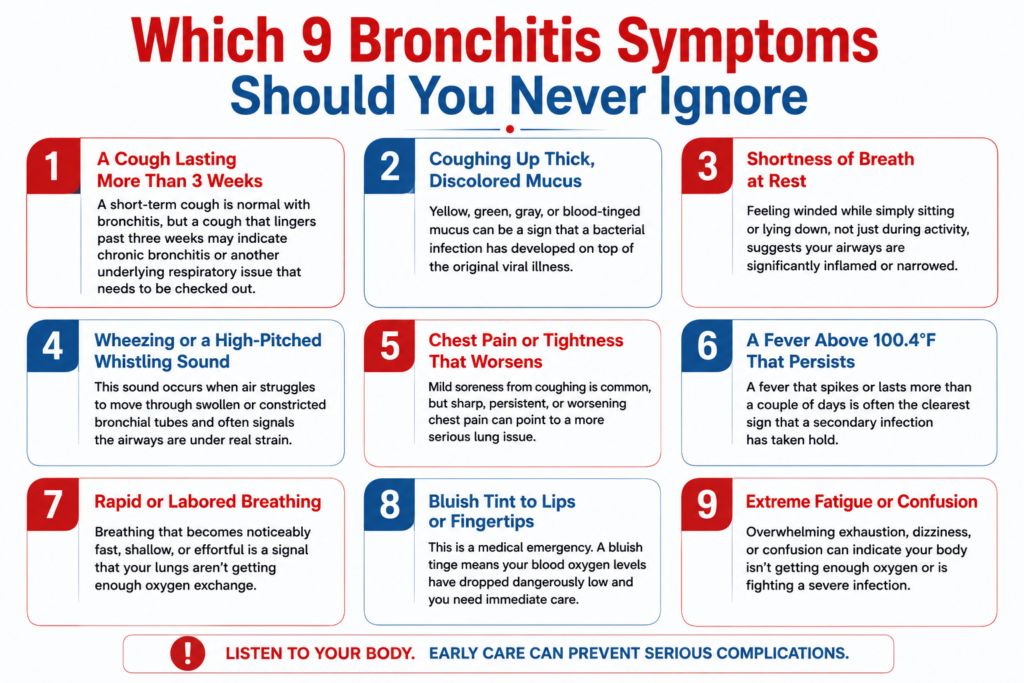
1. A Cough Lasting More Than 3 Weeks
A short-term cough is normal with bronchitis, but a cough that lingers past three weeks may indicate chronic bronchitis or another underlying respiratory issue that needs to be checked out.
2. Coughing Up Thick, Discolored Mucus
Yellow, green, gray, or blood-tinged mucus can be a sign that a bacterial infection has developed on top of the original viral illness.
3. Shortness of Breath at Rest
Feeling winded while simply sitting or lying down, not just during activity, suggests your airways are significantly inflamed or narrowed.
4. Wheezing or a High-Pitched Whistling Sound
This sound occurs when air struggles to move through swollen or constricted bronchial tubes and often signals the airways are under real strain.
5. Chest Pain or Tightness That Worsens
Mild soreness from coughing is common, but sharp, persistent, or worsening chest pain can point to a more serious lung issue.
6. A Fever Above 100.4°F That Persists
A fever that spikes or lasts more than a couple of days is often the clearest sign that a secondary infection has taken hold.
7. Rapid or Labored Breathing
Breathing that becomes noticeably fast, shallow, or effortful is a signal that your lungs aren’t getting enough oxygen exchange.
8. Bluish Tint to Lips or Fingertips
This is a medical emergency. A bluish tinge means your blood oxygen levels have dropped dangerously low and you need immediate care.
9. Extreme Fatigue or Confusion
Overwhelming exhaustion, dizziness, or confusion can indicate your body isn’t getting enough oxygen or is fighting a severe infection.
How Can You Tell if Bronchitis Is Getting Worse?
It isn’t always obvious when a case of bronchitis has crossed the line from ‘annoying but manageable’ to ‘needs medical attention.’ The table below compares what typical, improving bronchitis looks like versus signs that things are heading in the wrong direction.
| Symptom Area | Typical Bronchitis (Improving) | Warning Signs (Worsening) |
| Cough | Gradually loosens and decreases over 1-3 weeks | Persists past 3 weeks or suddenly intensifies |
| Mucus | Clear to white, gradually thins | Turns yellow-green, gray, or blood-streaked |
| Breathing | Slightly labored during activity only | Breathless at rest or while lying down |
| Fever | Low-grade, resolves within 48 hours | Rises above 100.4°F or returns after improving |
| Energy Level | Slow, steady improvement day to day | Increasing fatigue, weakness, or confusion |
| Chest Feeling | Mild soreness from coughing | Sharp pain, tightness, or pressure that worsens |
Can Bronchitis Turn Into Pneumonia?
Yes , bronchitis can progress into pneumonia, particularly when a viral infection opens the door for bacteria to take hold, or when the immune system is already weakened. While bronchitis affects the bronchial tubes, pneumonia involves inflammation and fluid buildup in the tiny air sacs of the lungs themselves, making it a more serious condition.
The shift from bronchitis to pneumonia often happens gradually.
A cough that seems to be improving suddenly returns with force, a fever that had resolved comes back, or breathing becomes noticeably more difficult. Because pneumonia can escalate quickly, especially in young children, older adults, and people with weakened immune systems, any resurgence of symptoms after a period of improvement deserves prompt medical evaluation.
Healthcare providers typically diagnose pneumonia through a physical exam, a listen to the lungs with a stethoscope, and sometimes a chest X-ray or pulse oximetry reading to check blood oxygen levels. Providers typically diagnose pneumonia through a physical exam and X-ray imaging services to check for fluid in the lungs.
Who Is Most at Risk for Bronchitis Complications?
Bronchitis is uncomfortable for anyone, but certain groups face a much higher risk of the illness turning into something more serious. Understanding where you fall on this list can help you decide how quickly to seek care.
- Adults over the age of 65, whose immune response and lung function naturally decline with age
- Infants and young children, whose airways are smaller and more easily obstructed
- Current or former smokers, whose airways are already inflamed and less able to clear mucus
- People with asthma, COPD, or other chronic lung conditions
- Individuals with weakened immune systems, including those undergoing chemotherapy or living with autoimmune conditions
- People with heart disease, since reduced oxygen levels place extra strain on the cardiovascular system
- Anyone regularly exposed to air pollution, dust, or chemical fumes at work or home
What these groups tend to share is a reduced ability to clear mucus and fight off secondary infection, whether that’s due to age, underlying lung damage, or a compromised immune response. For them, an illness that would be a mild inconvenience for a healthy adult can escalate into a serious respiratory event within just a day or two.
Because young children can decline quickly, don’t wait out worsening symptoms at home; our pediatric urgent care providers can evaluate your child the same day.”
How Can You Recover From Bronchitis Faster?
Most bronchitis cases resolve with time and supportive care. While there’s no way to make the illness disappear overnight, these strategies can ease symptoms and support a quicker recovery.
- Stay well hydrated; fluids help thin mucus so it’s easier to clear from the airways
- Rest as much as possible to give your immune system the energy it needs to fight the infection
- Use a humidifier or take a warm shower to loosen chest congestion
- Avoid smoke, dust, and other airway irritants until your cough has fully resolved
- Try warm liquids like broth or tea with honey to soothe throat irritation
- Use over-the-counter remedies as directed to manage fever or cough discomfort
- Avoid strenuous exercise until your breathing feels fully normal again
- Seek medical care promptly if symptoms persist beyond three weeks or intensify
Recovery timelines vary from person to person, but consistency matters more than any single remedy. Sticking with rest, hydration, and airway care every day rather than only when symptoms flare tends to shorten the overall course of illness and lowers the odds of a secondary infection taking hold while your defenses are still down.
Bottom Line
Bronchitis often starts small: a scratchy throat, a mild cough, a bit of fatigue, but it doesn’t always stay that way. Paying attention to your body’s signals, especially a cough that won’t quit, discolored mucus, breathing difficulty, chest pain, or persistent fever, can help you catch complications before they escalate. When in doubt, it’s always safer to have a healthcare provider listen to your lungs than to wait and hope symptoms fade on their own.
Trust the warning signs your body is giving you, and act on them. The team at We Care Urgent Care Plus is here for walk-in evaluations, on-site testing, and same-day treatment plans, so you can breathe easier and get back to your routine faster.
FAQs
Q1. Is bronchitis contagious, and how does it spread?
Acute bronchitis is usually caused by a virus and can spread through respiratory droplets from coughing or sneezing, as well as contact with contaminated surfaces. It’s typically contagious for the first few days of illness, similar to a cold or the flu.
Q2. What’s the difference between acute and chronic bronchitis?
Acute bronchitis is a short-term illness, usually triggered by a viral infection, that clears up within a few weeks. Chronic bronchitis is a long-term condition, often linked to smoking, defined by a persistent cough with mucus on most days for at least three months over two consecutive years.
Q3. Do antibiotics help treat bronchitis?
Most cases of acute bronchitis are viral, so antibiotics generally aren’t effective. They may be prescribed only if a healthcare provider suspects a secondary bacterial infection based on your symptoms and examination.
Q4. Can allergies or environmental triggers cause bronchitis-like symptoms?
Yes. Allergens, smoke, dust, and airborne chemical irritants can inflame the bronchial tubes and produce a cough and chest tightness that closely mimics bronchitis, even without an infection present.
Q5. When should children with bronchitis symptoms see a doctor?
Children should be evaluated if they have difficulty breathing, refuse fluids, appear unusually drowsy, have a persistent high fever, or if symptoms last longer than expected, since young children can decline more quickly than adults.