If you or someone you love has recently been diagnosed with rosacea, one of the first questions that likely came to mind is: Is rosacea contagious? It is a completely understandable concern. Rosacea causes visible redness, bumps, and skin changes that can resemble other contagious skin conditions, so the confusion is understandable.
The short answer is no, rosacea is not contagious.
You cannot catch it from another person, and it does not spread through physical contact, shared items, or any form of exposure. But there is a lot more to understand about this common skin condition, including what causes it, how it differs from other skin issues, and whether it can be managed long-term.
What Is Rosacea?
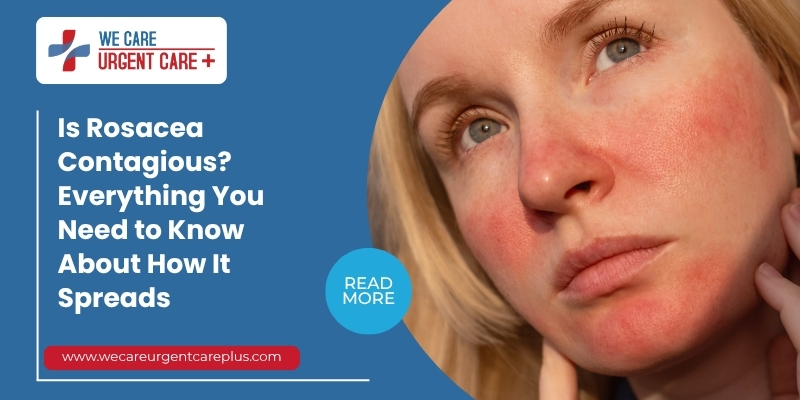
Rosacea is a chronic inflammatory skin condition that primarily affects the face. It typically appears as persistent redness, visible blood vessels, and sometimes pimple-like bumps across the cheeks, nose, forehead, and chin. In some cases, it can also affect the eyes in a form known as ocular rosacea.
- Rosacea is more common than many people realize.
- It affects an estimated 16 million Americans.
- Fair-skinned individuals over the age of 30 are most frequently diagnosed.
- Despite its prevalence, rosacea is widely misunderstood.
- It is often confused with acne, eczema, or even skin infections due to similar symptoms.
Is Rosacea Contagious? Setting the Record Straight
To be absolutely clear: rosacea is not contagious, not infectious, and not communicable in any way. You cannot pass rosacea to another person through touch, kissing, sharing towels, or any form of close contact. It is not something you can “catch” from being around someone who has it.
Is Rosacea Infectious?
No. An infectious condition is one caused by a pathogen, such as a bacterium, virus, or fungus that can enter the body and cause illness or disease. Rosacea does not work that way. It is not caused by an external organism that can be transferred between people.
Can Rosacea Spread from Person to Person?
It cannot. Rosacea is an internal condition driven by factors like genetics, immune system responses, and environmental triggers. There is no mechanism by which it can pass from one person’s body to another.
Is Rosacea a Communicable Disease?
Communicable diseases like the flu, COVID-19, or strep throat are diseases that spread between hosts. Rosacea does not meet any of the criteria for a communicable disease. It is a non-communicable, chronic skin condition.
Can You Catch Rosacea?
You cannot catch rosacea any more than you can catch high blood pressure or diabetes. These are conditions that develop within the body due to a combination of factors, and they are not transmitted between individuals.
Is Rosacea Bacterial or Viral?
This is one of the most common misconceptions about rosacea. People often assume that because it causes inflammation and bumps on the skin, it must be caused by bacteria or a virus. In reality, rosacea is neither bacterial nor viral.
Rosacea is a chronic inflammatory condition. While researchers have identified certain contributing factors, including abnormal immune responses, dysfunction in the skin’s vascular system, and reactions to specific environmental triggers, there is no single bacterial or viral cause that has been definitively established.
- Not Bacterial/Viral
Rosacea is neither a bacterial nor a viral condition, despite common misconceptions.
- Chronic Inflammation
It is classified as a chronic inflammatory skin disorder, not an infection.
- Multiple Factors
Linked to abnormal immune responses, vascular dysfunction, and environmental triggers.
- No Single Cause
No specific bacteria or virus has been proven to directly cause rosacea.
- Demodex Mites Link
Higher levels of Demodex folliculorum mites are often found on rosacea-affected skin.
- Gut Bacteria Role
Some studies suggest Helicobacter pylori may contribute to symptom flare-ups.
- Not Infectious
Even with these associations, rosacea is not contagious or spread between people.
Is Rosacea Caused by Infection?
Rosacea is not caused by an infection, even though its redness and inflammation may sometimes resemble infectious skin conditions. Unlike bacterial or viral infections, rosacea develops because of abnormal immune responses, blood vessel changes, and environmental triggers that affect the skin. Common rosacea triggers include heat, sun exposure, spicy foods, alcohol, and emotional stress, all of which can contribute to flare-ups without involving contagious pathogens.
Research suggests that rosacea may be linked to an overactive innate immune response in the skin, meaning the body’s defense system becomes hypersensitive and triggers inflammation even without an actual threat present. This is why rosacea flare-ups are often triggered by heat, spicy foods, sun exposure, alcohol, or emotional stress — not by bacteria, viruses, or other contagious pathogens.
How Does Rosacea Spread on the Skin?
- Rosacea is not contagious and does not spread from person to person
- It may appear to “spread” on the face, but this is actually disease progression, not infection
- It usually starts with occasional flushing or redness in the center of the face
- Over time, redness can become more persistent and cover larger areas of the face
- Blood vessels may become more visible as the condition progresses
- Some people may develop bumps, irritation, or thickened skin in affected areas
- This gradual worsening is often mistaken for “spreading,” but it remains limited to the same individual’s skin
- Progression can be slowed by identifying triggers and avoiding them
- A consistent skincare routine recommended by a dermatologist can help manage symptoms
- Medical treatment can reduce flare-ups and prevent further worsening
Rosacea Transmission Myths: Busted
Let us address some of the most common myths about rosacea transmission so you can separate fact from fiction.
Myth: You can get rosacea by touching someone’s face.
Fact: Rosacea cannot be transmitted through skin-to-skin contact of any kind.
Myth: Sharing makeup or skincare products with someone who has rosacea will give you rosacea.
Fact: Sharing products is generally not a good hygiene practice, but it will not give you rosacea. Rosacea does not live in cosmetics or skincare items.
Myth: Rosacea is an allergic reaction that others can trigger.
Fact: While rosacea has triggers, it is not an allergy, and it is not contagious in any allergy-related sense.
Myth: Rosacea is just bad acne that spreads.
Fact: Rosacea and acne are completely separate skin conditions with different causes and different treatments.
Myth: If rosacea is in your family, you “gave” it to your children.
Fact: Rosacea does have a genetic component, meaning it can run in families, but this is a matter of shared genetics, not disease transmission.
What Is the Difference Between Rosacea and Acne?
| Feature | Rosacea | Acne |
| Primary Cause | Chronic skin inflammation & immune response | Clogged pores & excess oil production |
| Background Redness | Yes, persistent facial redness & flushing | No redness, only around individual pimples |
| Visible Blood Vessels | Yes, telangiectasia is commonly present | No |
| Blackheads / Whiteheads | No | Yes, a defining feature |
| Bumps / Pimples | Pink or red bumps, no pus-filled heads | Whiteheads, blackheads, and inflamed pimples |
| Skin Sensation | Burning, stinging, or sensitivity | Tenderness around pimples, oily feeling |
| Who It Affects | Mostly adults 30+, often fair-skinned | All ages, skin tones, and skin types |
| Contagious? | No | No |
| Worsened By | Heat, sun, spicy food, alcohol, stress | Excess oil, bacteria, and hormonal changes |
| Treatment Approach | Anti-inflammatory medications, gentle skincare | Drying agents, salicylic acid, benzoyl peroxide |
Is Rosacea Contagious Through Contact, Including Eyes or Lips?
No. Even in cases of ocular rosacea where the condition affects the eyes, causing redness, dryness, and irritation, it cannot spread to another person through eye contact, shared towels, pillowcases, or any other form of contact.
Similarly, rosacea affecting the lips or the skin around the mouth is not transferable through kissing or any close physical interaction. Rosacea is not a herpes-type condition or any other pathogen-based condition that spreads through mucous membranes or direct contact.
People with rosacea can maintain normal, close relationships without any concern about transmitting the condition.
When Should You See a Doctor About Rosacea?
If you notice any of the following, it is a good idea to have your skin evaluated by a medical professional:
- Persistent facial redness that does not go away
- Recurring flushing or blushing, especially when it was not a pattern before
- Small visible blood vessels appearing on the nose or cheeks
- Acne-like bumps without blackheads or whiteheads
- Skin that burns, stings, or feels unusually sensitive
- Eye irritation, dryness, or redness alongside skin symptoms
Final Thoughts
Rosacea is a common, manageable skin condition that carries a significant amount of misinformation around it. The most important thing to know is this: rosacea is not contagious, not infectious, and cannot spread from person to person. It is not a disease you can catch or pass on; it is a chronic skin condition that can be effectively managed with the right guidance and care.
If you or a family member is experiencing persistent facial redness, irritation, or unexplained skin changes, early evaluation can help prevent rosacea symptoms from worsening. At We Care Urgent Care Plus, our medical team can evaluate skin-related concerns, recommend appropriate treatment options, and help you manage chronic skin flare-ups with confidence.
FAQs
Q1.Is rosacea autoimmune or allergic?
Rosacea is neither an autoimmune disease nor a true allergic condition. It is a chronic inflammatory skin disorder influenced by genetics, blood vessels, and environmental triggers.
Q2.Is rosacea dangerous?
Rosacea is generally not dangerous or life-threatening. However, it can worsen over time and may affect the eyes or quality of life if untreated.
Q3.Is rosacea contagious in babies?
Rosacea is not contagious at any age, including babies. It cannot be passed from person to person and is not an infection.
Q4. Can rosacea affect areas other than the face?
Yes, while rosacea primarily affects the face, it can also appear on the neck, chest, scalp, and ears, and may even impact the eyes in a form called ocular rosacea.
Q5. Does diet play a role in managing rosacea long-term?
Diet does not cause rosacea, but certain foods like aged cheeses, hot beverages, and fermented products can trigger flare-ups, making it helpful to track and avoid personal dietary triggers alongside medical treatment.